Fort Collins Optometrist Eye Exams
Have You Ever Worried About Not Passing Your Eye Exam?
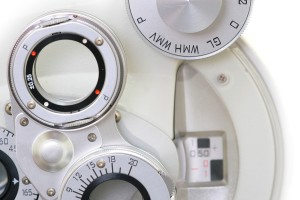
Testing your eyes for prescription glasses or contact lenses seems like a guessing game by your eye doctor but it really is more accurate than you think. The first part of the exam is usually an autorefraction that is performed by an eye technician instead of the optometrist. Autorefractors are computerized instruments that analyze your eyes “refractive state” or how much of a prescription you need. Autorefractors are considered to be objective tests since that have no reliance by the eye doctor on responses from the patient. Utilizing a LASER beam and complex “star wars” mathematics they only require a few seconds to analyze the prescription for your eyes.
Eye Exams One or Two
Does it seem like eye exams on or two are the norm? Do you worry about passing your eye exam? Most people don’t like either choice and feel like they are choosing something that is blurry. To some extent that is true and a normal part of the way eye testing has been done by optometrists for years. Vision tests are done by a “forced choice” method. That really means eye doctors make you choose between two views, even when there is little or no difference at times. This may seem counter intuitive, but it does help find your optometrist obtain more accurate reading for your eye glass prescription. If you are old enough to remember radios and TVs that had knobs to tune in the stations you will remember bracketing or tuning above and below the station in smaller and smaller steps to fine tune the end point. Subjective eye testing works the same way. Forced choice is well known in psychological testing, and vision testing really is a neuro psychological form of testing.
But Its Getting Worse Not Better!
Most of the time there is a “better view” between one and two. Sometimes there isn’t. At the endpoint of testing there is no longer a JND or just noticeable difference between the two views. The human perceptual system can only differentiate down to a degree that is limited by the cell sizes in the retina of the eyes. After this point your responses to subjective testing are no longer reliable. The loss of reliability is in an ironic way an assurance of reliability to you eye doctor. If you have been accurately closing in on an endpoint or tuning spot, and then start becoming random in your responses, chances are good the prescription will be fine tuned and accurate. On the other hand, if you are not accurate in narrowing the range at first, or do not display randomness at the end over a small area, the subjective vision testing may not be so good.
All Is Not Lost!
No Worries! Passing you eye exam really isn’t difficult. If that is the case we simply revert to relying more on objective tests independent of your subjective “better of worse” answers. In addition to the autorefractor findings, your optometrist will look at your old prescription and how well you see with it. Combined with your visual acuity when you are not wearing glasses we have a fairly good idea of what strength prescription eyewear you need. There is an older technique referred to as Retinoscopy that that optometrists used for years to help derive an accurate Rx. Retinoscopy adjusts a beam of light with lenses to find your prescription. This was the precurser to today’s computerized autorefractors. It also requires no verbal response. The advantage of retinoscopy is the ability of the eye doctor to monitor any variations in the distance you are focusing at. It adds a third opinion into the decision making when needed.
I Don’t Want To Be Stuck With The Wrong Prescription! (The Last Front On The War Against Indecision)
When all else fails, we will examine your eyes after dilation drops have kicked in. They also have the wonderful side effect of disrupting focusing up close. That allows your optometrist to check your eyes when they can no longer change focal distance and add errors into the readings. Autofraction after dilation can add yet another way of testing your eyes. Drops will alter the prescription slightly, but this change is predictable and can be compensated for. Sometimes we will take this reading a few times and even redo retinoscopy after dilation. Usually we can correct your vision to 20/20 even if you can’t make up your mind between one and two! People often wonder how young childrens eyes can be measured. The beauty of objective eye tests are that optometrists completely circumvent subjective responses with children.
So Why Not Let The Eye Computer Do All The Testing?
The short answer is it is not quite as good as the subjective testing your eye doctor uses. Passing your eye exam is not the point, we want you to have the best vision possible! The other answer is what would I do without refractions, go fishing? Not really, since the “refraction” is only a small part of testing eyes to assure vision is working correctly and the eyes are staying healthy. Someday computers will probably replace subjective tests entirely but that appears to still be a long way off. Autorefractors have been a blessing to underdeveloped countries where healthcare resources are severely limited. Technology continues to progress with new and refined ways of objectively measuring eye sight. Measurements are just starting to enter the realm where they can exceed your capacity to discriminate. Theoretically that is great but if you really can’t tell the difference from a visual perceptual level, it may not be a true improvement. They are also starting to exceed our ability to make prescriptions, but that part will catch up rapidly. The saying used to be 20/10 in 2010 (implying people would be able to wear lenses that improved their vision form 20/20 to 20/10 by 2010. We kind of missed that milestone but someday!!! Of course the years are going the wrong way now, lets just hope its not 20/30 in 2020!
Comments 2
Have you ever thought about publishing an ebook or guest authoring on other sites?
I have a blog centered on the same subjects you discuss and would love to have you share some stories/information.
I know my audience would value your work.
If you’re even remotely interested, feel free to shoot me an e mail.
Author
I would probably be willing to do that but I can’t seem to find an email for you that works. Let me know.
Thanks